From July to September 1986, the discovery of Pits No. 1 and No. 2 at Sanxingdui site marked the moment when the ancient Shu civilization “awoke to astonish the world” after slumbering for millennia. The year 2026 coincides with the 40th anniversary of the milestone excavation of the sacrificial pits at Sanxingdui. From July 24 to 26, the Academic Symposium Commemorating the 40th Anniversary of the Discovery of the Sacrificial Pits at Sanxingdui Site and Ancient Ivory Research and Conservation was held at the Exhibition International Hotel, Guanghan. The symposium was hosted by the Sichuan Provincial Institute of Cultural Relics and Archaeology (Sanxingdui Research Institute), the Sanxingdui Museum, and the Sanxingdui Management Committee, organized under the guidance of Specialized Committee on Xia and Shang Archaeology of the Archaeological Society of China, the Specialized Committee on Zooarchaeology of the Archaeological Society of China, and the Archaeological Society of Sichuan Province, and co-hosted by the Archaeological Site Museum Committee of Sichuan Museums Association.
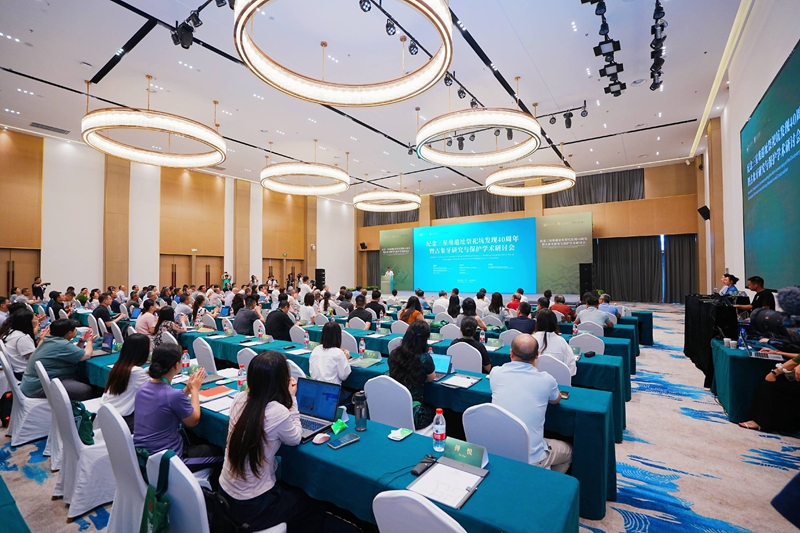
On the morning of July 24, Huang Chaoyang, Deputy Secretary of the CPC Deyang Municipal Committee and Mayor of the People’s Government of Deyang, announced the symposium open.Tang Fei, Member of the the Leading CPC Members’ Group of Sichuan Provincial Department of Culture and Tourism and Member of the the Leading CPC Members’ Group & Director General of Sichuan Provincial Cultural Heritage Administration, and Huang Yi, Member of the Standing Committee and Head of the Publicity Department of the CPC Deyang Municipal Committee delivered speeches; Rowan K. Flad, John E. Hudson Professor of Archaeology in the Department of Anthropology at Harvard University, delivered a speech on behalf of the international scholars. In their speeches, they paid high tribute to the experts, scholars, and professionals who have devoted themselves to the archaeological excavation and research at Sanxingdui over the years, as well as to those who have made outstanding contributions to the conservation, restoration, and study of the cultural relics unearthed from the site. They fully affirmed the research value of Sanxingdui for understanding the origins and development of Chinese civilization, and expressed their expectation that this symposium would further advance the systematic collation and publication of archaeological findings from Sanxingdui, promote breakthroughs and applications of key conservation technologies for cultural relics, and deepen the appreciation of the significance of cultural heritage preservation.The opening ceremony was presided over by Liu Zhiyan, Director of Sichuan Provincial Cultural Relics and Archaeology Research Institute.
Also present at the opening ceremony were Li Hongyong, Director of the Cultural Inheritance and Development Division of the Publicity Department of the CPC Sichuan Provincial Committee; He Zhenhua, Deputy Director General of Sichuan Provincial Cultural Heritage Administration; Wang Hong, Deputy Mayor of the People’s Government of Deyang Municipality; as well as relevant officials from the Sichuan Provincial Institute of Cultural Relics and Archaeology, the CPC Guanghan Municipal Committee and the People’s Government of Guanghan Municipality, the Sanxingdui Museum, and the Sanxingdui Management Committee.
This symposium closely followed the two main themes— comprehensive archaeological research at Sanxingdui and specialized ivory studies. It brought together over 100 leading experts and scholars from China and abroad in the fields of archaeology, cultural heritage conservation, and paleontology to collectively review the 40-year history of fieldwork and multidisciplinary research at Sanxingdui. Discussions centered on core topics including the layout of the Sanxingdui city, the nature and significance of the sacrificial pits, bronze production technologies, and interregional cultural interactions. At the same time, the symposium focused on cutting-edge specialized topics such as the provenance of ivory raw materials, processing techniques, ritual functions, and the conservation of deteriorated ivory. Through an interdisciplinary perspective, the symposium aimed to explore deeper into the cultural significance of the ancient Shu civilization, further refine the research and conservation framework for ancient ivory, and enhance the global visibility and academic influence of ancient Shu civilization studies on the world stage.
Following the opening ceremony, the symposium proceeded to the keynote speech session, moderated by Jay Xu, Member of the American Academy of Arts and Sciences. Four leading experts and scholars—Wang Wei, Member of the Academic Division of the Chinese Academy of Social Sciences; Rowan K. Flad, John E. Hudson Professor of Archaeology in the Department of Anthropology at Harvard University; Daniel C. Fisher, Professor Emeritus of Paleontology at the Museum of Paleontology, University of Michigan; and Ran Honglin, Research Fellow at the Sichuan Provincial Institute of Cultural Relics and Archaeology— delivered keynote speeches from the perspectives of macro-level civilization patterns, cross-regional resource exchange networks, archaeometric research on ancient ivory, and field archaeological evidence, establishing a new coordinate system for Sanxingdui research that integrates cutting-edge domestic and international perspectives.
This symposium featured two panel sessions—“Archaeological Discovery and Research” and “Ancient Ivory Research and Conservation”— which concurrently held thematic discussions in separate time slots. Bringing together cutting-edge findings from renowned scholars both domestically and internationally, the sessions delved into the cultural significance of the ancient Shu civilization from two major dimensions of comprehensive archaeological research at the Sanxingdui site and specialized ivory studies.
In the panel session of “Archaeological Discovery and Research”, experts and scholars presented a range of landmark academic insights on topics including the reconstruction of the urban layout and water management system of Sanxingdui ancient city, the chronological relationships and nature of the sacrificial pits, the technological characteristics of Sanxingdui’s craft production systems, and new perspectives on cross-regional resource exchange and multicultural interactions at Sanxingdui. Concurrently, the session also included a comprehensive review of research on the newly discovered sacrificial pits over the past five years, offering prospects for future directions in the study of Sanxingdui and the ancient Shu civilization.
In the panel session of “Ancient Ivory Research and Conservation”, experts and scholars presented a series of conservation research findings of significant reference value and broad applicability. These findings addressed specialized topics including the scientific interpretation of burial and preservation mechanisms of ancient ivory, innovative practices in dehydration and consolidation techniques for ancient ivory, analysis of ivory working techniques and exploration of their ritual significance, and provenance studies of ivory alongside research on the habitats and migratory environments of ancient elephants.
Participating experts reached a consensus that ancient ivory remains are a key medium for understanding the ancient Shu civilization and for tracing resource exchange networks on the Chengdu Plain during the Bronze Age. Looking ahead, the academic community will continue to pursue a multidisciplinary and internationally collaborative research approach, comprehensively advancing the archaeological investigation of the entire Sanxingdui site, as well as the research, exhibition, and long-term conservation and sustainable utilization of its diverse excavated artifacts.
With the 40th anniversary of the excavation of the sacrificial pits as a significant occasion, this symposium brought together multidisciplinary perspectives spanning field archaeology, cultural heritage conservation, zooarchaeology, paleontology, and comparative studies of global civilizations. By bringing together scholarly expertise from around the world, the event comprehensively showcased the latest research findings and academic trends concerning the Sanxingdui city site, ritual system, and regional cultural interactions. It further deepened practical explorations into the systematic conservation of waterlogged and degraded ivory, providing multi-layered and multi-dimensional evidence for understanding the exchange and mutual learning between ancient Bronze Age civilizations of the East and West, as well as the pluralistic yet integrated pattern of Chinese civilization.