On November 2, 2026, local time, the “Glory of Bronze Civilization: Sanxingdui-Jinsha Sites Salon” was held at the Chinese School of Classical Studies at Athens in Greece. The event was hosted by the Chinese School of Classical Studies at Athens and the Chengdu Jinsha Site Museum, co-organized by the International Communication Center of Chengdu Radio and Television, and supported by the Xinhua News Agency News and Information Center. Experts and scholars, university faculty members and students, and media representatives from China and Greece attended the event.
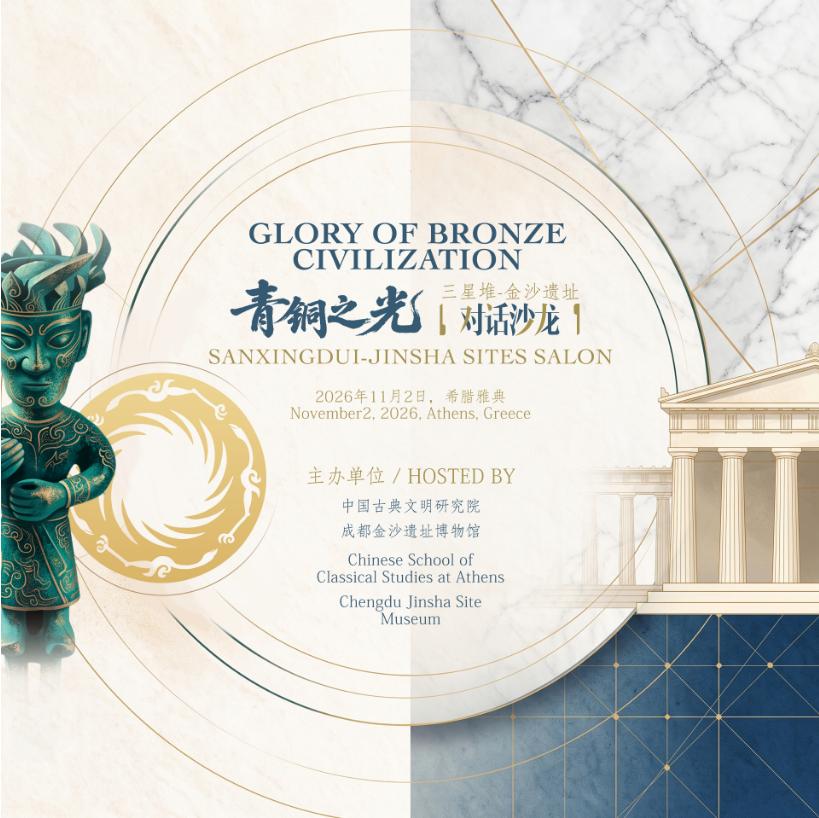
Main visual of the event.
From the special exhibition “Ancient Greece: Mythology, Heroes, and Destiny” held at the Chengdu Jinsha Site Museum in January 2025 to the opening of “A Journey to Ancient Greece: Archaeological Explorations” at the Sanxingdui Museum in July 2025, the ancient Greek civilization and the ancient Shu civilization have continued to move closer to each other through cultural relics and exhibitions. Against this backdrop, the event further built a platform for Chinese and Greek scholars to exchange ideas and discuss heritage protection through a thematic exhibition and an expert salon.
The Chinese School of Classical Studies at Athens, where the event was held, is a classical civilization research institution established in Athens in November 2024, and is also the first permanent classical studies research institution established in Greece by an Asian country. The institution, affiliated with the Chinese Academy of Social Sciences, aims to promote academic exchanges between China and Greece and mutual learning among civilizations. It has obtained authorization to conduct archaeological excavations in Greece and launched the excavation of the Angelokastro site, the first joint China-Greece archaeological project.
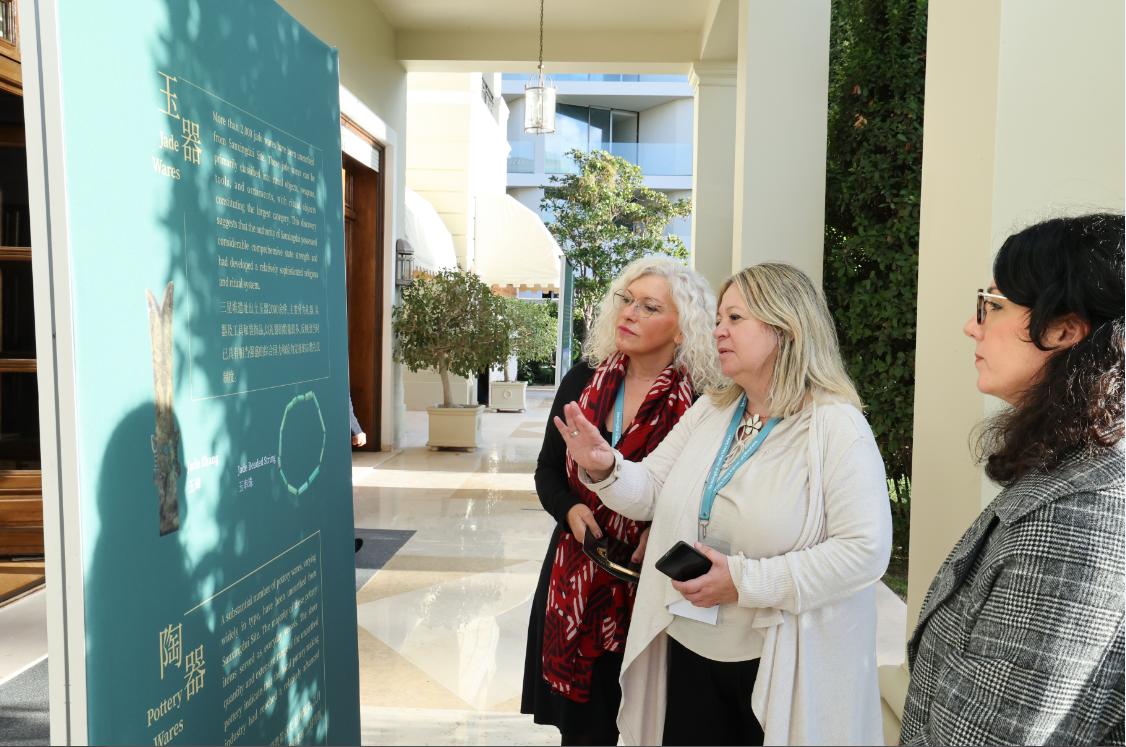
Visitors explore the “Glory of Bronze Civilization: Sanxingdui-Jinsha Sites Exhibition”.
To introduce the Greek public to the ancient Shu civilization, the event specially set up the “Glory of Bronze Civilization: Sanxingdui-Jinsha Sites Exhibition” in the outdoor and indoor spaces of the Chinese School of Classical Studies at Athens. Opening with illustrated panels on the geographical location, site overview, and representative artifacts of the Sanxingdui-Jinsha Sites, the exhibition led visitors into the ancient Shu civilization in southwestern China. The physical exhibits featured carefully curated 3D-printed artworks of representative artifacts unearthed from the Jinsha Site. The Sun and Immortal Birds motif told the story of sun worship, a spiritual belief shared by civilizations around the world; the gold mask invited a cross-civilizational comparison with the famous Mask of Agamemnon unearthed in Athens; the bronze standing figure showed the connection between Sanxingdui and Jinsha cultures; and the ten-section jade cong tube reflected the open and inclusive character of the Sanxingdui-Jinsha cultures and the historical process through which Chinese civilization moved from diversity to unity. Through the combination of illustrated panels and 3D-printed replicas of representative exhibits, the exhibition vividly presented the unique artifact forms, artistic aesthetics, and spiritual beliefs of the ancient Shu civilization and offered a platform for Greek visitors to gain a closer understanding of the Sanxingdui-Jinsha Sites. It provided a tangible visual reference for the keynote speech by Zhang Qing, Director of the Chengdu Jinsha Site Museum, during the expert salon.
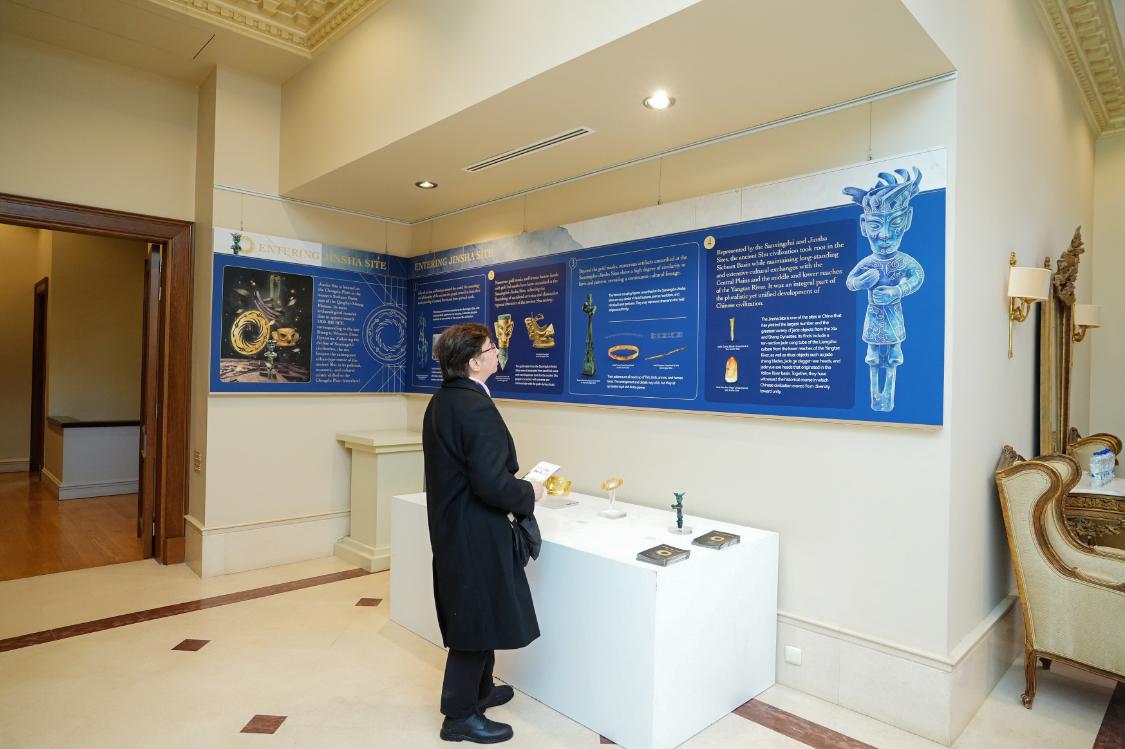
Visitors explore the “Glory of Bronze Civilization: Sanxingdui-Jinsha Sites Exhibition”.
Georgios Steiris, President of the Department of Philosophy of the National and Kapodistrian University of Athens, mentioned in an interview that he had visited the Sanxingdui Museum and the Jinsha Site Museum in person two years ago. “If you see the real artifacts there with your own eyes, they will deliver the greatest impact.” In his view, what was most impressive was not the objects themselves, but the “spiritual connotations behind the artifacts”—“They are not merely decorations trying to create a sense of beauty, but the ways through which ancient artisans sought to establish a connection with deities and the surrounding nature.”
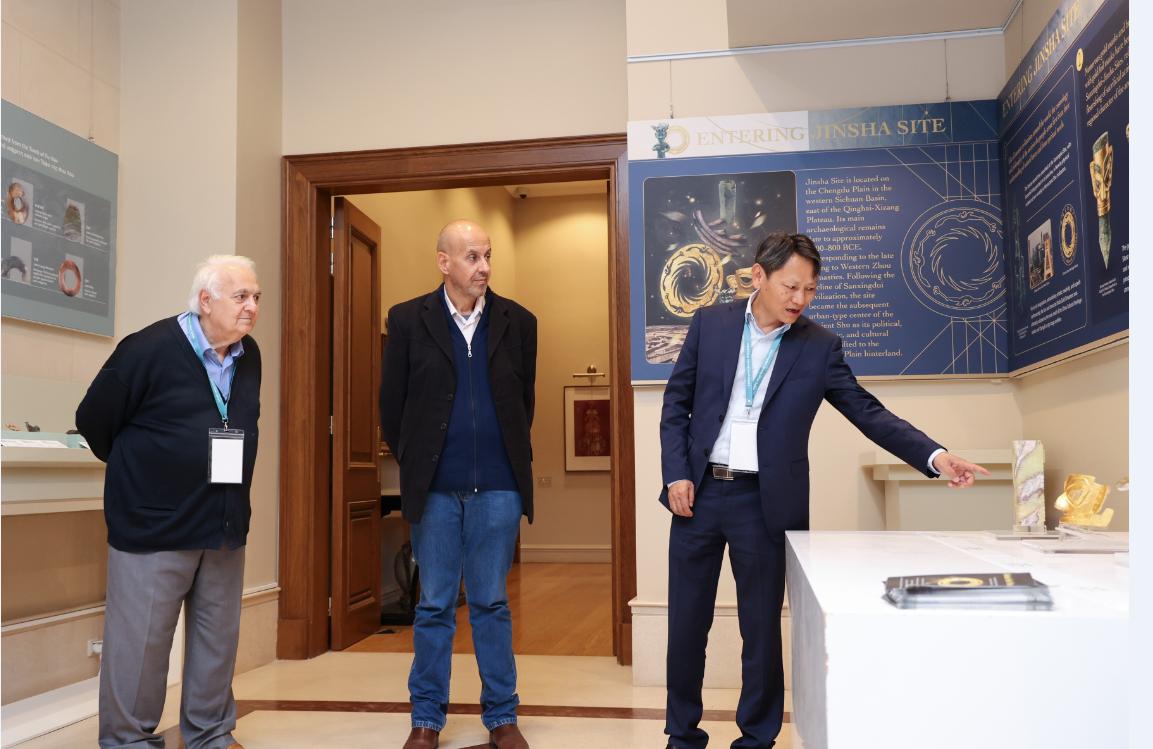
Director Zhang Qing guides Greek experts through the exhibition.
China-Greece Dialogue: Objects, Technology, and Ideas
The afternoon salon was moderated by Li Xinwei, Director of the Chinese School of Classical Studies at Athens. The event opened with the documentary Echoes of Civilization: Dialogue Between Chinese and Greek Civilizations, through which Chinese and Greek guests approached each other’s histories and spiritual worlds. Three experts—Zhang Qing, Director of the Chengdu Jinsha Site Museum; Agamemnon Tselikas, Director of the Greek Institute of Ancient Documents, Advisor to the Library of the Hellenic Parliament, and Team Member of the Antikythera Mechanism Research Project; and Georgios Steiris, President of the Department of Philosophy of the National and Kapodistrian University of Athens—then delivered keynote speeches in turn. From the perspectives of objects, technology, and ideas, they delved progressively deeper and explored the encounters and exchanges between Chinese and Greek civilizations.
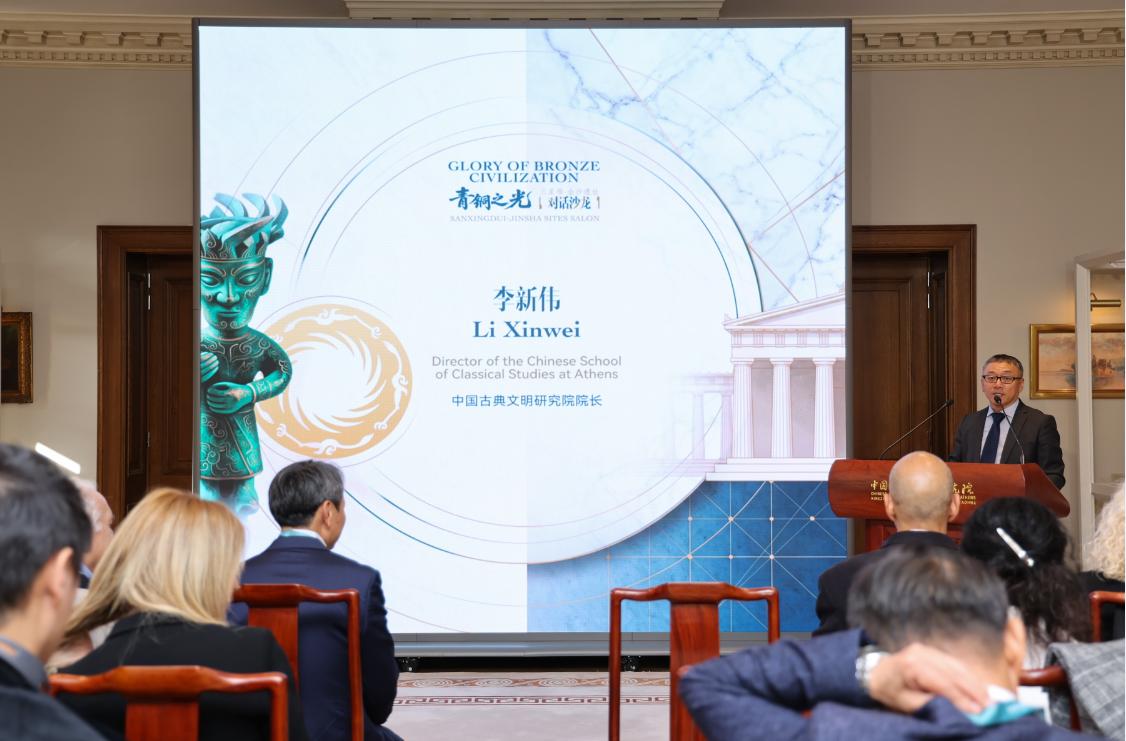
Li Xinwei, Director of the Chinese School of Classical Studies at Athens, moderates the salon.
Zhang Qing pointed out that Sanxingdui and Jinsha were two successive cities belonging to the same cultural tradition. Together, they constituted the core development framework of the ancient Shu civilization and provided important evidence for the “diversity in unity” pattern of Chinese civilization.
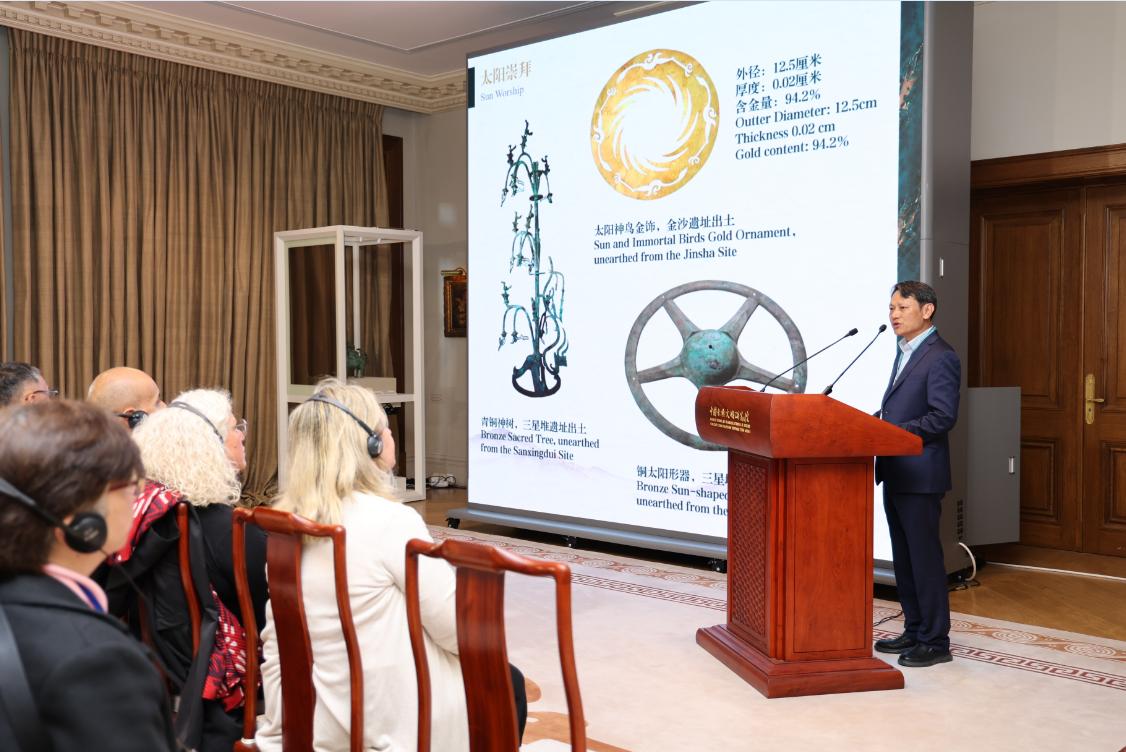
Zhang Qing delivers a keynote speech.
Agamemnon Tselikas’s speech focused on the archaeological research, protection, and display of the artifacts of Antikythera. The Antikythera mechanism is a bronze gear device dating to around the second century BC. It could calculate and display astronomical information such as lunar phases, solar and lunar eclipses, and planetary motions, and is regarded as one of the most complex mechanical devices of the ancient world. Agamemnon Tselikas has long been involved in deciphering and studying its inscriptions. He said: “This is an opportunity and a topic that can stimulate scientific curiosity and interest among both Chinese and Greek participants.”
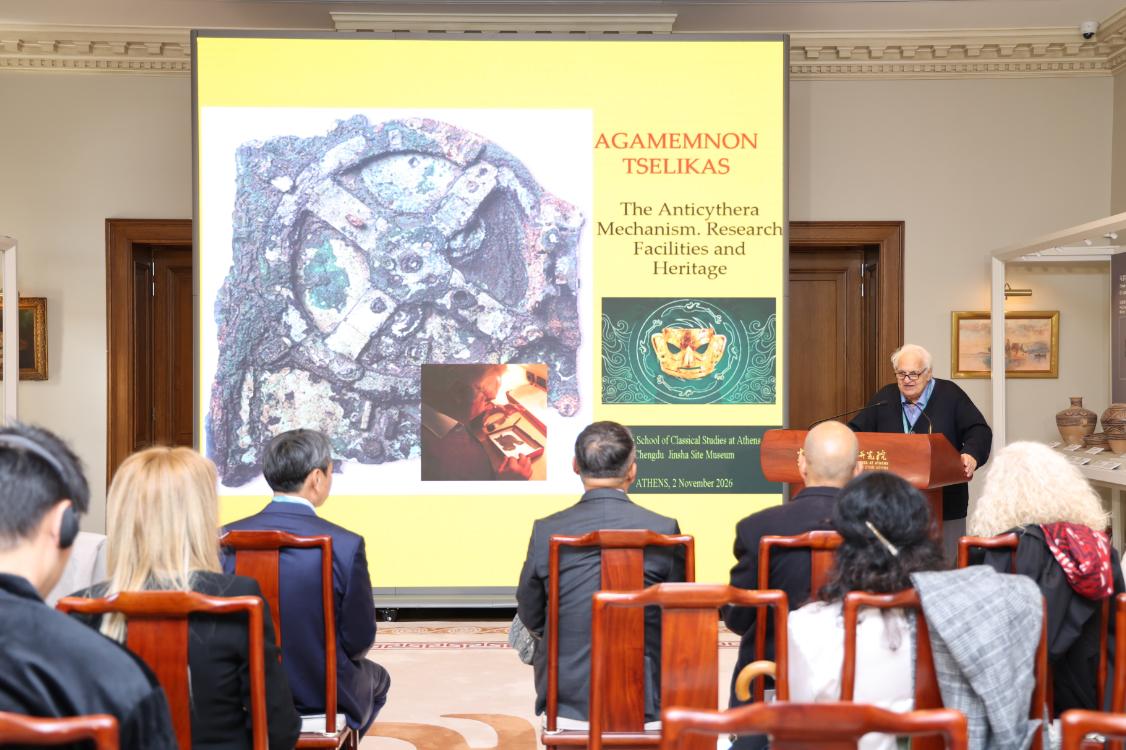
Agamemnon Tselikas delivers a keynote speech.
Georgios Steiris reviewed records in ancient Greek literature about the Eastern land of silk and Eastern peoples and, in combination with relevant accounts of Gan Ying, a Chinese diplomat of the Eastern Han Dynasty, explored historical clues concerning early mutual cognition and indirect contact between the Greek and Chinese civilizations. He stated that the connection between the two civilizations might be earlier than previously commonly believed, and that researchers from the two countries should deepen research on cultural and intellectual exchanges since ancient times.
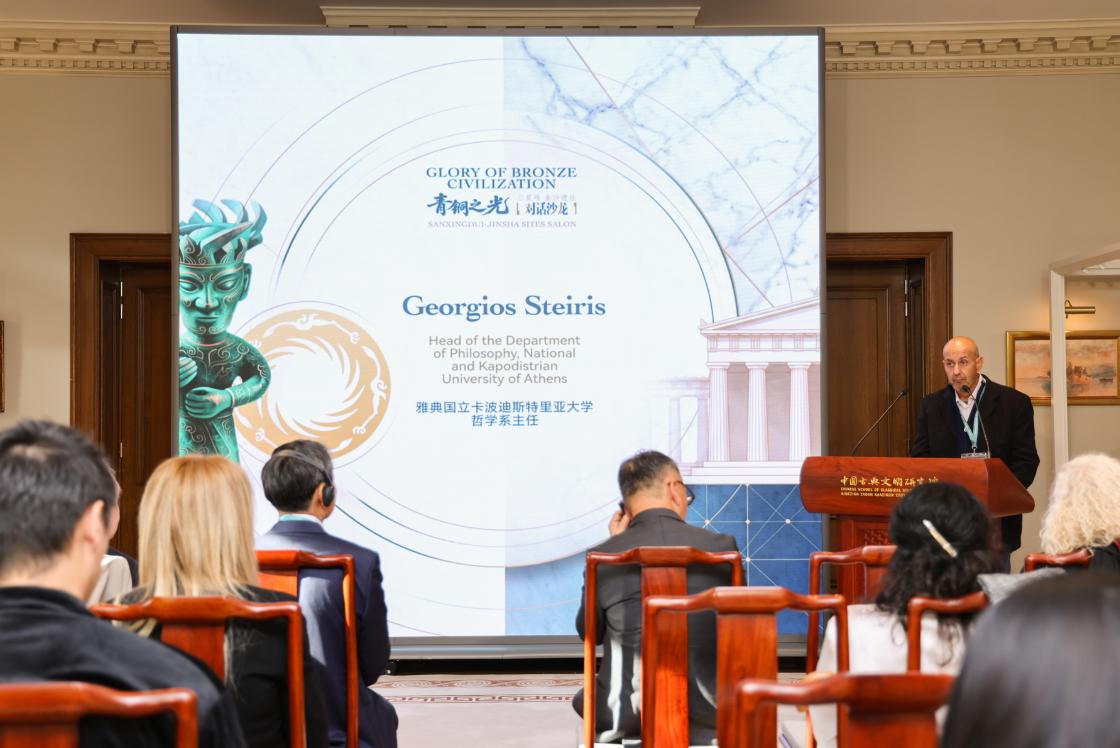
Georgios Steiris delivers a keynote speech.
During the salon discussion and Q&A session, Chinese and Greek experts exchanged views on topics such as the similarities and differences between the ancient Shu and ancient Greek civilizations, as well as the protection and inheritance of cultural heritage. They engaged with faculty members and students present. Agamemnon Tselikas believed that such intellectual exchange was “very, very important”, prompting him to consider visiting China again. He also expressed the hope “to enable younger students to come to Greece to discuss, exchange ideas, and learn... This exchange itself embodies the spirit of humanism.”